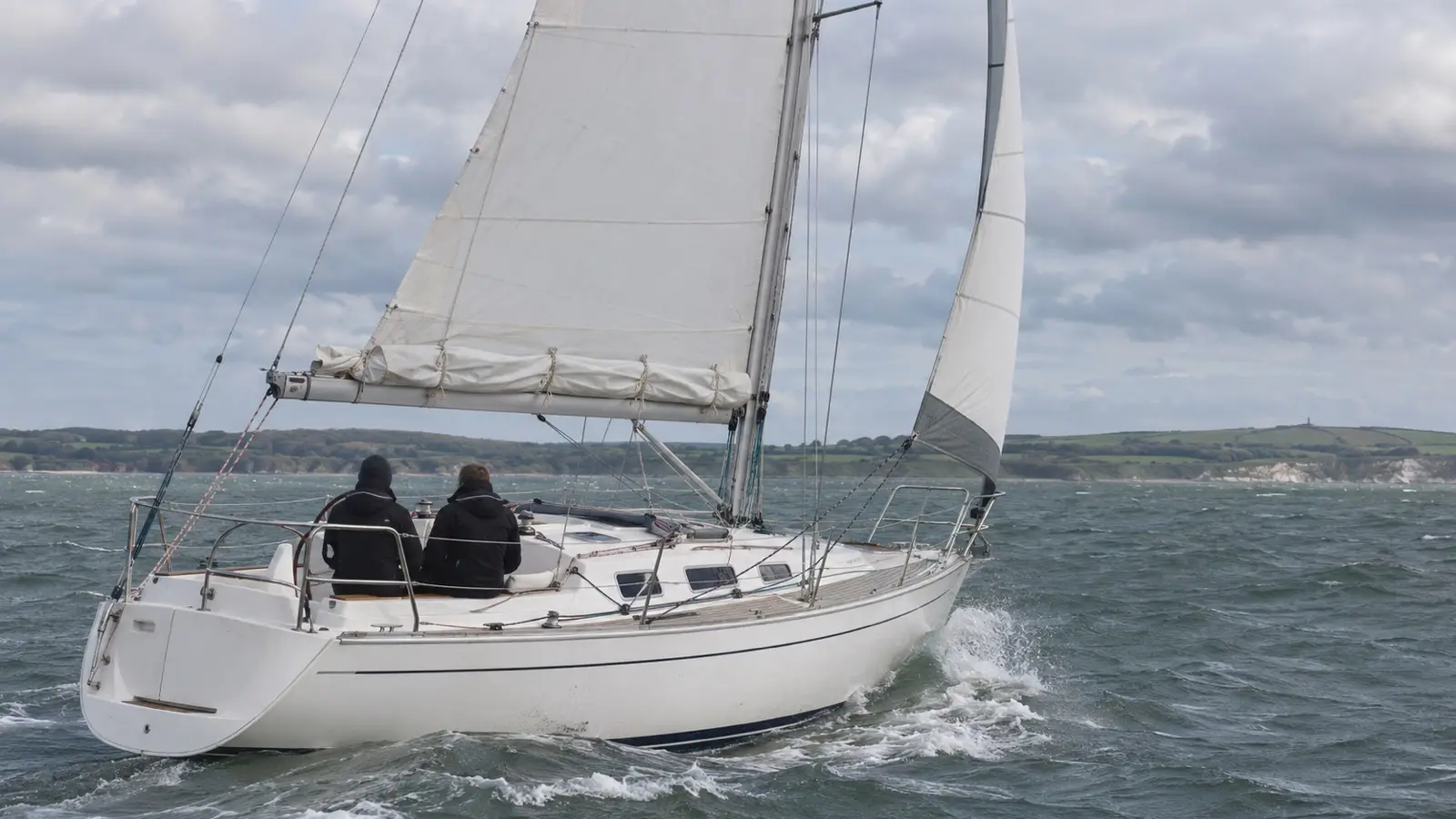

Reefing a sail means reducing its area so the boat stays upright, balanced and under control as the wind builds. On a typical cruising yacht the first reef goes into the mainsail at around Force 5, which is 17 to 21 knots. The better trigger is the boat itself: too much heel, a helm that fights you, or the bow rounding up into the wind in the gusts.
To slab reef a mainsail, you take the power out of it, lower the halyard, secure a new tack at the mast, re-tension the halyard and pull a new clew down to the boom. Two practised crew can do it in a couple of minutes.
The rule we teach every crew on the Solent is to reef early. If you are wondering whether it is time, it is.
What is reefing?
Reefing is shortening sail by taking part of a sail out of use. It lowers the sail's centre of effort and flattens it, so the boat heels less and steers more easily.
Slab reefing lowers the mainsail part of the way and secures a new, higher corner at each end of the boom. Furling reefing rolls part of the sail away, round the forestay for a genoa or inside the mast or boom for a furling main.
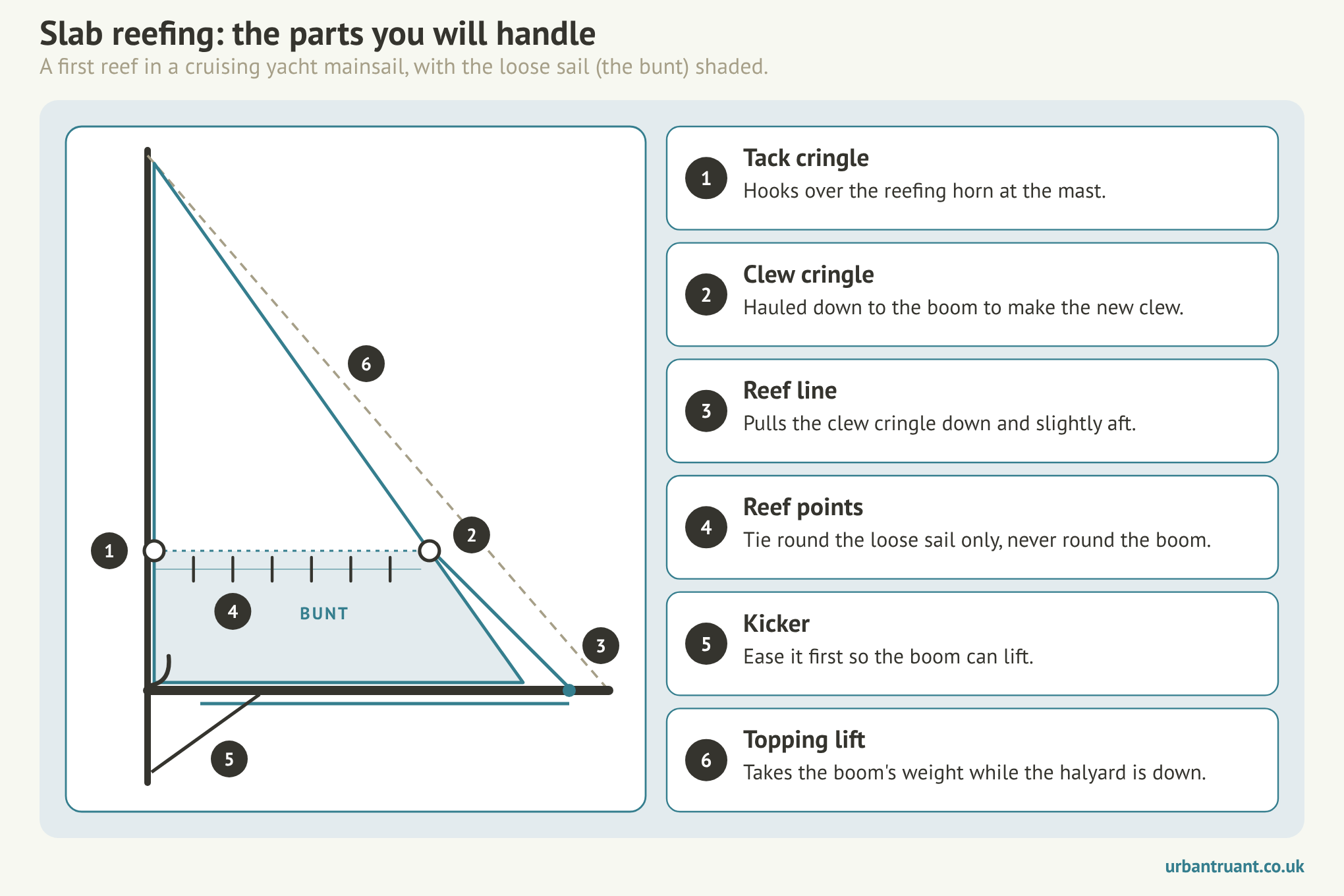
- Cringles: reinforced eyes in the sail. Each reef has a tack cringle at the luff and a clew cringle at the leech.
- Reef line: the line that hauls the clew cringle down to the boom.
- Reef points: short ties used to gather up the loose canvas, called the bunt.
- Shaking out a reef: returning to a larger sail area.
When should you reef?
Reef when the boat is overpowered, or when you can see it is about to be. Wind strength gives you a starting point and the boat confirms it.
| Beaufort force | Wind speed | What the boat tells you | Typical sail plan, 32 to 40 ft yacht |
|---|---|---|---|
| Force 4 | 11 to 16 knots | Lively, easy on the helm | Full sail, watch the gusts |
| Force 5 | 17 to 21 knots | Heeling hard in gusts, heavy helm | First reef, some genoa rolled |
| Force 6 | 22 to 27 knots | Rail down, hard to hold a course | Second reef, genoa well rolled |
| Force 7 | 28 to 33 knots | Hard work for crew and boat | Deeply reefed, and question being out |
Wind speeds from the Met Office Beaufort wind force scale, verified 2 November 2026. A heavy long-keeled boat will carry full sail longer than a light modern one.

Three situations catch crews out:
- A building forecast. Put the reef in before you leave the berth. It takes two minutes alongside, and shaking a reef out in a dropping breeze is far easier than putting one in as it rises.
- Sailing downwind. Boat speed subtracts from the wind you feel on deck, so a run feels gentler than it is. Our points of sail guide explains why a run feels calmer than it is.
- Wind against tide. In the Solent a breeze against a spring tide builds a short, steep sea, particularly in the western Solent towards Hurst. A comfortable Force 5 on the flood can feel like a Force 6 once the tide turns.
The decision starts with the forecast. Reading a forecast, the barometer and the sky is the meteorology module of our RYA Day Skipper online theory course, which you can complete at home before a practical week.
How to reef a mainsail, step by step
This is the slab reefing sequence we teach, with the calls we use. The diagram shows the six parts you will handle.
- Brief the crew and clip on. Decide who takes the helm, the mast, the halyard and the reef line. Anyone going forward clips on before leaving the cockpit. "Stand by to reef."
- Settle the boat. Sail close hauled or on a close reach with the genoa drawing so you keep steerage, or heave to. Ease the mainsheet until the main spills wind. "Easing the main."
- Ease the kicker and take up the topping lift, if fitted, so the boom can rise and does not drop onto the sprayhood.
- Lower the halyard to the mark until the tack cringle reaches the gooseneck. A whipping on the halyard at that point saves guesswork. "Halyard down."
- Secure the new tack over the reefing horn or pull the tack reef line tight. "Tack on."
- Re-tension the halyard until the luff is firm with no horizontal creases. "Halyard made."
- Haul in the reef line until the clew cringle sits tight on the boom and the new foot is flat. "Reef line made."
- Sail on and tidy up. Ease the topping lift, reset the kicker and sheet in. Tie the reef points round the loose bunt only, passing them between the sail and the boom, never round the boom itself.

Single-line reefing
Single-line reefing pulls the tack and clew down with one line, so steps 5 and 7 become one haul from the cockpit. The long line run builds friction, so check the clew has come right down to the boom; a reef that looks finished from the cockpit is often slack at the leech.
Reefing the headsail and furling mainsails
Most yachts you will train on or charter carry a roller-furling genoa, and charter fleets often have furling mains.
| System | How it reefs | What to watch |
|---|---|---|
| Slab or single-line main | Halyard down, new tack and clew secured | Kicker eased, clew fully down |
| Roller-furling genoa | Sail rolled round the forestay | Ease the sheet under control, then move the sheet car forward |
| In-mast furling main | Sail rolled into the mast | Work the outhaul and furling line together |
| In-boom furling main | Sail rolled into the boom | Boom angle must be right or the sail rolls unevenly |
The sheet car is the step most crews miss. As the genoa gets smaller its clew rises, so the car needs to come forward or the top of the sail twists open and flogs.
Which sail should you reef first?
Let the helm decide. If the boat has heavy weather helm and keeps rounding up, reef the main first, because the power aft is turning her into the wind. If she is balanced on the helm but heeling too far, roll away some genoa first.
On most Solent charter yachts, with a large genoa and a modest main, a rising breeze usually calls for both: a first reef in the main and a few rolls in the genoa, keeping the helm light.
How to shake out a reef
Work through the same sequence in reverse, close hauled or on a close reach with the main eased.
- Untie every reef point first. A forgotten tie will tear the sail when you hoist.
- Ease the kicker and take up the topping lift.
- Ease the reef line and free the tack from the horn.
- Hoist to full height, re-tension the luff, then set the kicker and sheet in.
Reefing mistakes we see on the Solent
- Waiting for the gust to pass. By the time the crew agree it is time, every job on deck is harder. Reef at the first doubt.
- Leaving the kicker on. The boom cannot lift and the reef line will not bring the clew down.
- Letting the halyard run before the tack is ready. The sail drops in a heap on the coachroof. Lower to the mark, then stop.
- Tying reef points round the boom. If the reef line fails, the load comes onto the ties and the sail tears.
- Going to the mast unclipped. Reefing happens in exactly the conditions where a slip matters.
Where you learn to reef on an RYA course
Reefing is in the practical syllabus at every level of sail cruising training, and each level asks more of you.
- Competent Crew: you do the work. The RYA lists "changing sails, reefing, and tying essential knots" among the skills on its five-day course (RYA course description, page updated 31 March 2026). On our RYA Competent Crew course you rotate through the mast, halyard and reef line until the sequence is automatic, and our guide sets out what the Competent Crew week covers.
- Day Skipper: you make the call. The syllabus asks you to "reef, shake out reefs and change sails to suit prevailing conditions", so you decide when, brief the crew and run it. Read about the five days of the Day Skipper practical or book Day Skipper on the Solent from Hamble Point Marina.
- Coastal Skipper: you plan for it. Second reefs at night and a sail plan for a passage where the breeze will build feature on the Coastal Skipper course.
At Urban Truant, with a maximum of three students to an instructor, every student puts reefs in and shakes them out over the week.
Frequently asked questions
Does reefing slow you down?
Often it makes you faster. An overpowered yacht heels, slides sideways and needs so much rudder that the rudder acts as a brake. Back on her feet, she usually points higher and sails quicker.
Can you reef downwind?
With furling or single-line systems you often can, carefully. With slab reefing the main is pressed against the shrouds on a run, so the halyard will not come down cleanly. Come up to a close reach or heave to first, and expect the wind to feel much stronger as you turn.
How many reefs does a yacht have?
Most cruising mainsails have two or three slab reefs. Furling sails can be reefed to any size, though they set less well when deeply rolled.
Should you reef before dark?
On a passage, yes, if there is any chance you will need it overnight. Working at the mast is harder and less safe in the dark.
Ready to put a reef in for real?
Reading the sequence gets you the order of jobs. Doing it on a heeling yacht with spray coming aft is what makes it stick. Our sailing courses run from Hamble Point Marina, from complete beginner to Coastal Skipper.