

The RYA Competent Crew course is five days living aboard a cruising yacht, learning to be a useful member of the crew. It needs no previous experience, there is no exam, and you finish with the RYA Competent Crew certificate, which is the first rung of the RYA sail cruising scheme. Most people take it as five consecutive days on the water, though it can be split across weekends.
Whether you should take it is a different question, and it is the one people actually argue about. If you have never been on a yacht, or you have been a passenger on one and want to stop being a passenger, this is your course. If you have several seasons of crewing behind you and can already reef, berth and steer a compass course, you can reasonably skip to Day Skipper, and I will set out below how to tell which of those you are.
I have run Competent Crew weeks from Hamble Point Marina for over 20 years. This guide covers what the RYA asks for, what you will actually learn, what a week on the Solent looks like, and an instructor's answer to the question of who should skip it.
RYA Competent Crew at a glance
The RYA sets no entry requirements for Competent Crew. The course is defined by its length, its format and the certificate at the end.
| RYA Competent Crew | |
|---|---|
| Course length | 5 days |
| Formats | 5 consecutive days, or 3 weekends, or 3 days plus a weekend |
| If you hold RYA Start Yachting | Can be completed in 3 or 4 days |
| Required experience | None |
| Recommended minimum age | 12 |
| Where it runs | Aboard a cruising yacht, living on board |
| Assessment | Continuous, by your instructor; no written or practical exam |
| Certificate | RYA Competent Crew Course Completion Certificate |
| What it leads to | RYA Day Skipper |
Source: RYA Course Finder, RYA Competent Crew Practical Course, accessed 7 September 2026.
At Urban Truant we run it as five consecutive days, and we only have a maximum of three students to an instructor with a cabin each. You can see dates for the five-day course we run from Hamble Point on the course page.
What you learn on the RYA Competent Crew course
You learn to do every job on deck that a skipper needs help with, and to look after yourself and the boat while you do it. The RYA syllabus sets out the areas, and by Friday you will have done all of them for real rather than watched.
Sail handling. Bending on, setting and reefing sails, and using sheets and halyards with the winches that control them. Reefing (reducing the sail area) in particular is a skill people are pleased to have when the breeze gets up on a charter.
Ropework and the essential knots. Coiling, stowing and securing lines to cleats and bollards, handling warps, and the knots that come up every day on a yacht: figure of eight, clove hitch, rolling hitch, bowline, round turn and two half hitches, single and double sheet bend, and reef knot. You will tie a bowline several dozen times during the week and the skill will still be there in your hands years later.
Helming. Steering a compass course under sail and under power, and steering on all points of sail. If those words are new, our guide to how the points of sail work is a useful read before you arrive.
Safety. Fire precautions and what to do if one starts, the rules for wearing harnesses and lifejackets, how to recover a man overboard, how to make a MAYDAY call on the radio, when to use distress flares and how to launch and board a liferaft.
Seamanship and manners afloat. Keeping a proper lookout, handling a dinghy under oars, the customs around burgees and ensigns, courtesy to other boats in harbour, and the skipper's responsibility to the environment.
Weather. Where forecasts come from and how to read the Beaufort scale, which is the shorthand every forecast uses for wind strength. Our colleagues at Sailing Course Online have written a full guide to the Beaufort scale if you want the numbers in advance.
Life on board. Cooking, keeping the boat tidy, standing a watch, and all the day-to-day routines that make a yacht run.
One thing I teach that is not in the RYA syllabus: put the cups in the sink before you pour. It was a tip I was given very early in my own sailing career, and it sounds silly, but try pouring boiling water into mugs on the worktop just as the skipper decides to tack. At best it makes a complete mess. At worst you get boiling water on your shoes.
There is no theory exam and nothing to revise. Assessment is continuous. If you have joined in, listened and shown you can do the jobs, you get the certificate on Friday. And if you don't, we will have failed you.
What a Competent Crew week looks like on the Solent
Every course starts on the pontoon at Hamble Point with a pile of kitbags, more clothes than anyone will need, and a mixture of excitement and nerves. Both are normal, and I tell every crew on the first morning that nobody is expected to know anything yet.

Monday. Stow your kit, meet the boat and the rest of the crew. Safety briefing, lifejackets, where everything lives. Knots and rope handling alongside, then out of the river for the first sail to a new harbour for your first night on board.
Tuesday and Wednesday. Out into the Solent proper. Sail handling, steering on a heading, tacking and gybing, with everyone rotating through the helm and the foredeck. Evenings are spent in a different harbour each night, usually across on the Isle of Wight, at Cowes or Yarmouth, or over at Lymington. Picking up a mooring buoy and coming alongside in a marina are both part of the week.
Thursday. A longer passage, often with an early start to catch a tidal gate, and a night sail. Standing watch after dark, keeping a lookout and watching the lights of the shipping in Southampton Water is the part most people remember.

Friday. Sail back to the Hamble, wrap up, debrief, certificate. Celebrate!
By about Wednesday something changes. A group of strangers who spent Monday waiting to be told what to do start anticipating what needs doing, and you have a crew. Watching that happen is the reason I still enjoy running this course.
Meals are shared. I often take on the main cooking so the crew get some downtime, and there is a glass of wine at the end of most days. On our yachts everyone has a cabin of their own.
Do you need Competent Crew before Day Skipper?
The RYA does not require the certificate. It does require the experience, and for most people Competent Crew is the sensible way to get it.
The RYA does not list Competent Crew as a prerequisite for the Day Skipper practical course. What it lists is experience: 5 days on board a sailing yacht, 100 miles logged and 4 night hours, plus basic sailing ability and navigation knowledge to Day Skipper shorebased level. A Competent Crew week delivers the days, the miles and the night hours in one go, which is why it sits where it does in the scheme.
Source: RYA Course Finder, RYA Day Skipper Practical Sailing course, accessed 7 September 2026.
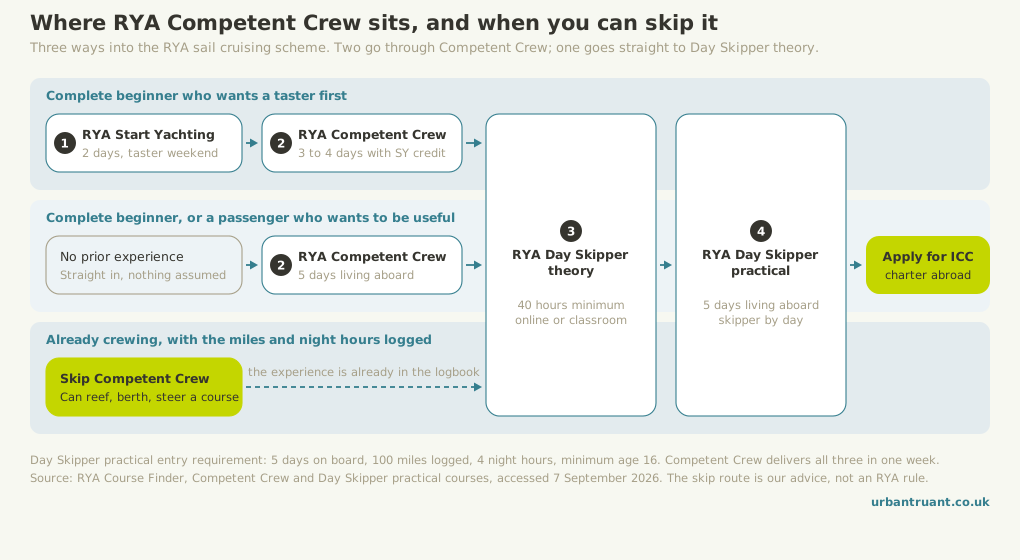
The online forums are full of people who skipped Competent Crew and were glad they did, and people who watched someone else skip it and wished they had not. Both are right, about different people. Here is how I would sort it.
| What you have | What I would do |
|---|---|
| Never been on a yacht | Competent Crew. If you want a taste first, a Start Yachting weekend, then the shorter Competent Crew route |
| A few days as a guest on friends' boats, never had the helm in a breeze, unsure what half the words mean | Competent Crew |
| Dinghy sailing background, little or no cruising yacht time | Competent Crew. The wind sense transfers; winches, warps, wheels and living aboard do not |
| Several seasons crewing on cruising yachts, comfortable on the foredeck and the helm, can reef and berth, have the 5 days, 100 miles and 4 night hours in a logbook | Skip it. Start the Day Skipper theory now and book the practical |
| Own a yacht, have the miles, no paperwork | Skip it. Day Skipper theory, then the practical, or a day of own boat tuition if what you want is confidence on your own boat |
If you are in the bottom two rows, the right next step is studying the Day Skipper theory at home first, then the practical. Our guide to what the Day Skipper practical asks of you sets out the entry requirements in full.
What gives people away
The people who struggle on Day Skipper practical after skipping Competent Crew are rarely short of enthusiasm. They are short of the small physical habits that a week as crew builds without you noticing.
It shows in the first hour. A rope wrapped around a winch in the wrong direction. Turning the wheel the wrong way because every boat they have sailed had a tiller. Not knowing, when the instructor says ease the sheet, whether that means let it out or pull it in. Standing on the wrong side of a loaded line. None of these are dangerous on their own, but Day Skipper practical is a week of learning to take charge, and you cannot take charge of a boat while you are still learning where to put your hands on it.
Competent Crew exists so that by the time you are asked to skipper, the crew work is automatic. That is the whole point of the course, and it is why we tell people who are unsure to take it. Nobody has ever come back to us and said the week was wasted.
Is Competent Crew worth it?
For a beginner, yes, and it is one of the better weeks you can spend on the water. It is worth it for three sorts of people in particular.
If you have been invited sailing and want to be useful rather than sit in the cockpit being handed things, this gives you the skills and the vocabulary to get stuck in.
If you are aiming at Day Skipper and a charter abroad, this is the foundation. You need to understand crewing before you can lead a crew, and the miles and night hours count towards your Day Skipper entry requirements.
If you want an active week that is a long way from a desk, with a different harbour every night, five days on a yacht on the Solent takes some beating.
It is not worth it if you can already do the syllabus. If reefing, berthing, mooring and steering a compass course are things you do rather than things you have read about, you will spend the week being polite about learning things you know. Go to Day Skipper.
If you are in the first three groups, our Competent Crew course dates are on the course page, and spring and autumn weeks on the Solent often give the best sailing of the year.
Start Yachting or Competent Crew?
Start Yachting is a two-day introduction and Competent Crew is the full five-day course. Think of them as two ways to begin.
The two-day Start Yachting weekend covers the basics of steering, sail handling and life on board, and is the right first step if you want to find out whether yacht sailing is for you before committing to a week. The RYA recognises it as credit towards Competent Crew, so a Start Yachting holder can complete Competent Crew in three or four days rather than five.
If you already know you want to sail, go straight to Competent Crew. The five days build on each other, and the people who take it in one block tend to get the most from it.
What comes after Competent Crew
The natural next step is RYA Day Skipper, which is where you move from crewing to taking charge.
Day Skipper is in two parts. The theory course covers navigation, tides, weather, passage planning and the collision regulations, and the RYA specifies a minimum of 40 hours of study for it (RYA Day Skipper theory syllabus, current at September 2026). Most of our Competent Crew students work through the Day Skipper theory online over the following couple of months, then come back to us for the five-day Day Skipper practical on the Solent.
With the Day Skipper practical certificate you can apply to the RYA for an International Certificate of Competence, which is what most Mediterranean charter companies want to see before they hand over a yacht. Our colleagues at Sailing Course Online have a step-by-step guide to applying for an ICC.
There is no rush. Some people take a year between Competent Crew and Day Skipper and fit in some casual sailing to consolidate. Others are back the following month. Both work.
Frequently asked questions
How long is the RYA Competent Crew course?
Five days. It can be taken as five consecutive days, over three weekends, or as three days plus a weekend. If you hold the RYA Start Yachting certificate it can be completed in three or four days.
How much does the Competent Crew course cost?
At Urban Truant the five-day course is £1,299 (September 2026), which includes your own cabin on board, all meals aboard and refreshments, mooring fees, fuel, use of wet weather gear and safety equipment, and RYA certification. Shorter routes for Start Yachting holders are priced on the course page. Prices at other schools vary, and it is worth checking what is included, since some quote a lower headline figure and charge separately for meals, mooring and fuel, or run with five students to an instructor rather than three.
Do I need any experience before Competent Crew?
No. The course is designed for complete beginners and assumes nothing.
What is the minimum age for Competent Crew?
The RYA recommends a minimum age of 12. Call us to talk through a place for a younger sailor, since it depends on the individual and who they are sailing with.
Does the RYA Competent Crew certificate expire?
No. It is a course completion certificate and it does not need renewing.
Is there a Competent Crew theory course?
No. Competent Crew is entirely practical and has no theory element or exam. The first theory course in the scheme is Day Skipper theory, which most people take after Competent Crew and before the Day Skipper practical.
Can Competent Crew be commercially endorsed?
No. Commercial endorsement applies to Day Skipper practical and above.
What should I bring?
Warm layers, soft-soled non-marking shoes, sun protection, a washbag, towel, sleeping bag and pillow, a change of clothes for evenings ashore, and a soft kitbag rather than a hard case. We provide lifejackets, harnesses and wet weather gear. And don't forget to bring a sense of humour!
Come and join a crew
If you are not sure whether Competent Crew or Day Skipper is your next step, ring us on 01489 250 040 and tell us what you have done. We would rather put you on the right course than the next course.