
An ICC powerboat licence is the International Certificate of Competence (ICC) validated for power, and for most UK powerboat drivers the way to get one is the two-day RYA Powerboat Level 2 followed by an application to the RYA. There is no separate ICC course. The RYA issues the certificate on the strength of a practical qualification you already hold, or a pass in an ICC assessment.
Powerboat Level 2 validates your ICC for power up to 10 metres on coastal waters, which covers the RIBs, sports boats and small cabin boats most people hire or tow abroad. You need to be 16 or over to apply, the ICC lasts five years, and European rivers and canals need one extra step, the CEVNI test (RYA, checked October 2026).
If you have a trip in mind and no certificate yet, the plan is short: two days on the water at Hamble Point, then an online application. This guide covers what the ICC is, what it lets you drive, how to lift the 10 metre limit, and the details that hold applications up.
What is an ICC powerboat licence?
An ICC is a certificate, issued in the UK by the RYA, that shows officials and hire companies abroad that you are competent to handle a pleasure craft. Its full name is the International Certificate for Operators of Pleasure Craft. People call it a licence, and abroad it does the job of one. Formally it is evidence of competence, issued under United Nations Resolution No. 40.
Each ICC lists the categories it is valid for. There are two groups, and the RYA can only issue an ICC with at least one from each (RYA ICC-3 Notes, version dated 25 November 2025):
- Type of vessel: power, sail or personal watercraft
- Type of water: coastal waters, inland waters or both
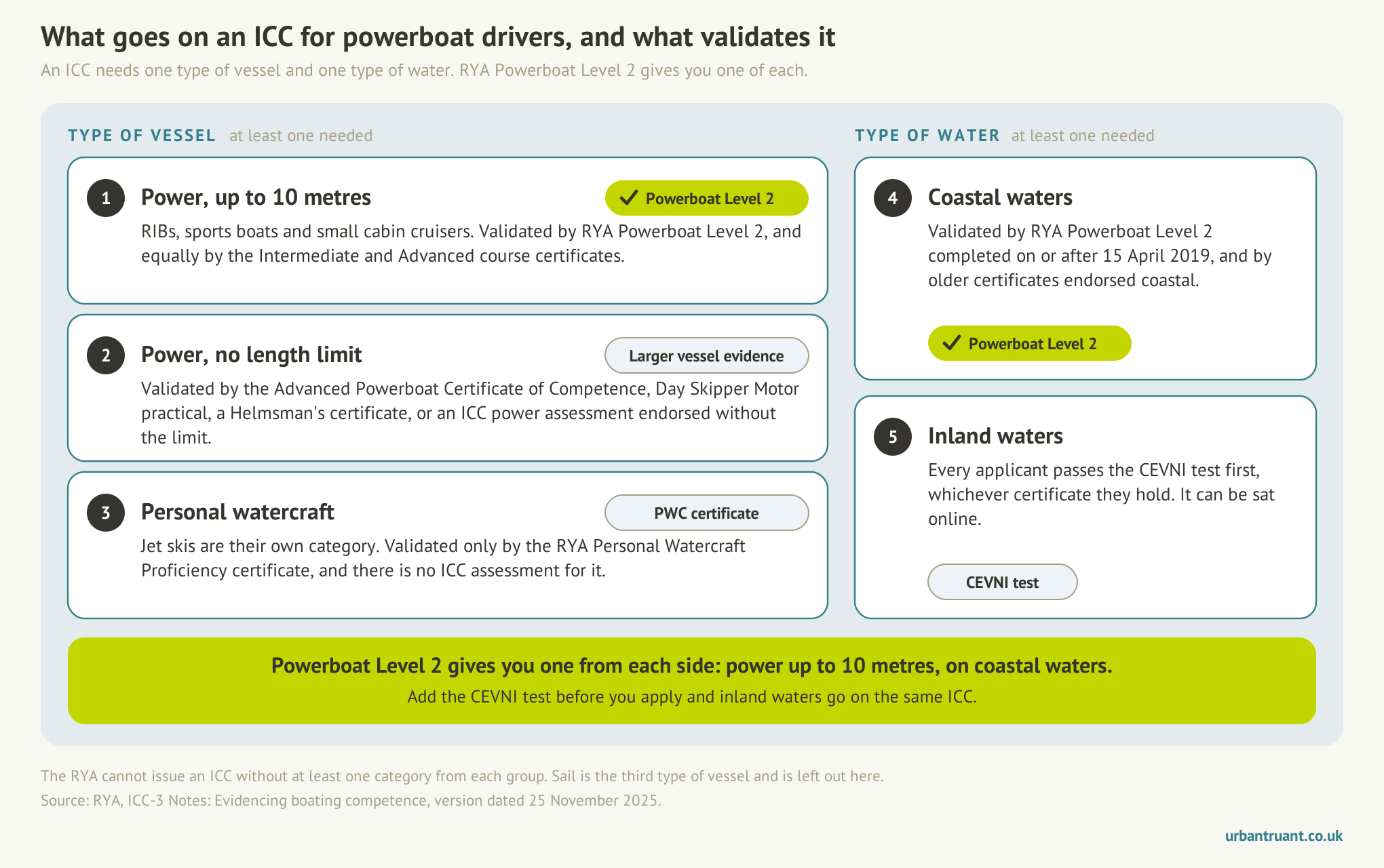
"ICC powerboat licence" is shorthand for an ICC with the power category validated. Depending on the evidence you send, that category is either restricted to vessels up to 10 metres length overall or carries no length restriction.
The RYA publishes the full rules on its ICC pages.
Can you get an ICC with Powerboat Level 2?
Yes. An RYA Powerboat Level 2 certificate completed on or after 15 April 2019 validates an ICC for power up to 10 metres and for coastal waters (RYA ICC-3 Notes, November 2025). That is one category from each group, so the certificate on its own is enough to apply.
The course takes two days, has no entry requirements and is open from age 12 (RYA, March 2026). Ours runs from Hamble Point Marina on the Solent with three students to an instructor, and our guide to what the two days cover sets out the syllabus.
Powerboat Level 2 does not validate inland waters or personal watercraft. We cover these later.
If your certificate is dated before 15 April 2019
Older certificates were endorsed either coastal or inland, and the endorsement decides what the ICC shows. A coastal endorsement works exactly as a current certificate does. An inland endorsement validates power up to 10 metres and no water category, so the RYA cannot issue an ICC on that certificate alone.
The fix is one more piece of evidence. For inland waters, pass the CEVNI test. For coastal waters, the RYA accepts an RYA Essential Navigation and Seamanship certificate, a Day Skipper shorebased certificate or higher, or a pass in the ICC coastal waters assessment. A short online navigation course is usually the quickest of the three.
What can you drive abroad with a powerboat ICC?
An ICC gained through Powerboat Level 2 covers powered pleasure craft up to 10 metres length overall. That takes in RIBs, sports boats, day boats and small cabin cruisers, which is most of what hire bases around the Mediterranean rent by the day.
Three things sit outside it:
- Boats over 10 metres. You need the power category without the length restriction, explained below.
- Jet skis. Personal watercraft are their own ICC category. The only evidence the RYA accepts is the RYA Personal Watercraft Proficiency certificate, and there is no ICC assessment for it (RYA ICC-3 Notes, November 2025).
- Paid work. The ICC is a leisure certificate. Once money changes hands, paid work needs a commercial endorsement.
One note for sailors: every ICC issued for sail also carries power up to 10 metres, so the holder can drive a tender. If you already have a sailing ICC, read the card before you book anything.
How do you get an ICC for a powerboat?
There are two routes, and the right one depends on whether you already drive.
Route 1: take RYA Powerboat Level 2
If you are new to powerboats, or self-taught and happy to be shown a tidier way of doing things, this is the route. Over two days you cover launching and recovery, close-quarters handling, coming alongside, securing to a buoy, anchoring, an introduction to driving at planing speed and recovering a person from the water.

You finish with a certificate that does not expire, and that certificate is your evidence for the ICC. Our Solent course dates are on the course page.
Route 2: the ICC assessment
If you have years of driving behind you and no certificate, you can be assessed instead. The RYA says applicants who "already have the required level of competence can take ICC assessments to demonstrate their competence". Assessments are arranged through an RYA recognised training centre acting as an ICC test centre.
The power assessment and the coastal waters assessment are separate certificates. An assessed candidate needs both, or the power assessment plus a Day Skipper shorebased certificate or higher for the coastal category, which you can gain through a shorebased navigation course studied at home. If your handling is sound and your pilotage is rusty, a day of tuition on your own boat beforehand is time well spent.
What to send the RYA
You apply online through your MyRYA account, and you can only apply for yourself. Have these ready (RYA ICC application page, checked October 2026):
| Item | Detail |
|---|---|
| Proof of nationality | A copy of your passport or national identity card |
| Proof of address | A document confirming your home address |
| Evidence of competence | A copy of your Powerboat Level 2 certificate, plus any second certificate for extra categories |
| Photograph | Passport style, in colour, on a plain light background, as a JPG or PDF under 5MB |
The RYA quotes approximately 21 working days from the date it receives an application, and it will only post the ICC to the address printed on it. Allow six weeks before you travel. The form is on the RYA's ICC application page.
How do you lift the 10 metre limit?
You lift it by showing the RYA competence on a larger vessel. In the RYA's words, "where the applicant has demonstrated that they are competent to drive a larger powerboat, motor cruiser or barge, the 10m restriction is lifted" (RYA, August 2026).
The RYA's ICC-3 Notes set out which evidence validates which version of the power category:
| Evidence | Power category | Coastal waters |
|---|---|---|
| RYA Powerboat Level 2 (completed on or after 15 April 2019) | Up to 10 metres | Yes |
| RYA Intermediate Powerboat or higher course completion certificate | Up to 10 metres | Yes |
| RYA/MCA Advanced Powerboat Certificate of Competence | No length restriction | Yes |
| RYA Day Skipper Motor practical certificate | No length restriction | Yes |
| RYA Helmsman's course completion certificate | No length restriction | No |
| RYA Inland Waterways Helmsman certificate | No length restriction | No |
| ICC assessment for power | Up to 10 metres or no restriction, as endorsed | Separate assessment |
Source: RYA, ICC-3 Notes: Evidencing boating competence, version dated 25 November 2025.
Two lines in that table surprise people. The Intermediate and Advanced Powerboat course certificates validate the same categories as Powerboat Level 2, so neither removes the limit. The restriction comes off with the Advanced Powerboat Certificate of Competence, which is the exam, and our guide to the Advanced Powerboat course and exam explains how the two differ. The exam expects background knowledge to Yachtmaster™ Offshore shorebased level, a marine radio certificate and a first aid certificate, and the Coastal Skipper and Yachtmaster™ theory, studied online covers the first of those.
For an owner moving up to a motor cruiser, the direct routes are a Day Skipper Motor practical or an ICC power assessment endorsed without the restriction.
Do you need CEVNI for inland waterways?
Yes. Every applicant who wants the inland waters category must first pass the CEVNI test, whichever practical certificate they hold. CEVNI is the code of signs and rules used on European inland waterways. It is not in use in the UK, so no UK practical course covers it (RYA ICC-3 Notes, November 2025).
The test is a multiple choice paper and there is no separate CEVNI certificate. Passing it lets the RYA validate the inland category on your ICC. You can sit the CEVNI test online with us before you apply, so both water categories go on the card at once.
Which shorebased certificates count towards an ICC?
Three shorebased certificates can each validate a water category on an ICC, and a fourth sits alongside it. None of them replaces time on the water: the power category always comes from a practical certificate or an assessment.
| Shorebased certificate | What it does for your ICC | Who it is for |
|---|---|---|
| CEVNI test | Validates inland waters. Every applicant who wants that category needs it | Anyone heading for European rivers and canals. Sit the test online before you apply |
| RYA Essential Navigation and Seamanship | Validates coastal waters when sent with a Powerboat Level 2 certificate completed before 15 April 2019 and endorsed inland | Holders of an older inland certificate. Study it online at your own pace |
| RYA Day Skipper shorebased, or higher | Validates coastal waters | Experienced drivers pairing it with the ICC power assessment. The shorebased theory can be studied at home |
| RYA Short Range Certificate | Nothing on the ICC itself. It is the operator's certificate for a marine VHF | Anyone driving a boat with a radio fitted. Start with the online radio course |
Source: RYA, ICC-3 Notes: Evidencing boating competence, version dated 25 November 2025.
On the standard route you need none of these to apply, because Powerboat Level 2 validates one category from each group. The CEVNI test is the one to add if rivers or canals are anywhere in the plan.
Do you need an ICC to hire or drive a powerboat abroad?
In most of the places UK powerboaters go, yes, or near enough that travelling without one is a gamble. The RYA's country guidance gives the position for visiting skippers as "Required. ICC recommended" for Spain and Portugal, "Essential. ICC recommended" for Croatia, and "Yes. ICC recommended" for Greece and for Italian coastal waters (RYA, Evidence of Competence Abroad, updated 28 August 2026).

The picture is less tidy than those lines suggest. The RYA notes that "of the 56 UNECE countries able to accept the resolution, the UK is one of only a handful which have fully adopted Resolution No. 40". Acceptance therefore varies from country to country, and the ICC remains the document the RYA recommends carrying in each of the countries above.
Two habits save trouble. Ask the hire company, in writing, what evidence it wants before you pay a deposit, which is the RYA's own advice. And if you are launching your own boat from a foreign slipway, check the local rules first, because site-specific requirements can apply. The RYA keeps country-by-country guidance up to date.
Where powerboat ICC applications go wrong
Most problems come from a mismatch between the certificate and the trip. These are the ones to check before you apply.
An inland certificate from before April 2019. It validates power up to 10 metres and no water category, so the application cannot be completed without the CEVNI test or evidence for coastal waters.
A canal or river holiday on a coastal ICC. The French canals and the Dutch and German waterways are inland waters. Without the CEVNI test the inland category stays blank.
Expecting it to cover a jet ski. Hire bases that rent RIBs often rent personal watercraft too. The power category does not extend to them.
A driver under 16. Powerboat Level 2 is open from 12, with certificates for under-16s endorsed for use under the supervision of a responsible adult. The ICC has a minimum age of 16, so younger drivers wait for theirs.
No radio certificate. The ICC says nothing about the VHF. To use a marine radio you need a marine radio operator's certificate, and charter and hire companies frequently ask to see one.
Leaving it late. At roughly 21 working days, an application made a fortnight before the ferry will not be back in time.
Frequently asked questions
How much does an ICC powerboat licence cost?
The ICC application is free for RYA members, provided the membership is current when the application is processed. Non-members pay the RYA an application fee, which is shown on the RYA's ICC pages. If you do not yet hold a qualifying certificate, the course is the main cost, and current prices are on our course page.
How long does it take to get an ICC?
Two days for Powerboat Level 2 if you need it, then approximately 21 working days for the RYA to process the application.
How long does an ICC last?
Five years, after which you renew it with the RYA. The Powerboat Level 2 certificate behind it does not expire.
Can I apply for an ICC online?
Yes, through your MyRYA account. A paper form is also available. You can only apply for yourself.
Is there an ICC test for powerboats?
Only if you have no qualifying certificate. Holders of Powerboat Level 2 apply with the certificate and sit no further test. Experienced drivers without one can take the ICC assessment at an RYA recognised training centre.
Does an ICC cover jet skis?
Only if the personal watercraft category is validated, and that needs the RYA Personal Watercraft Proficiency certificate.
Can a 14-year-old with Powerboat Level 2 get an ICC?
Not yet. The RYA's minimum age for an ICC is 16. The Powerboat Level 2 certificate does not expire, so it is ready to send in at 16.
Is the ICC the same as RYA Powerboat Level 2?
No. Powerboat Level 2 is the training and the certificate you earn on the water. The ICC is a separate document the RYA issues on the strength of it, for showing abroad.
Do I need an ICC in the UK?
No. The UK does not require the skipper of a pleasure vessel to hold an ICC. Our guide explains whether you need a licence in UK waters.
Your next step
If you already hold Powerboat Level 2, apply to the RYA now and add the CEVNI test if rivers or canals are in the plan. If you do not, the certificate is two days away. We teach on the Solent in Highfield RIBs with three students to an instructor, and you leave with the evidence the RYA asks for.
Ring us on 01489 250 040 if you are unsure which route fits, or book your two days at Hamble Point.