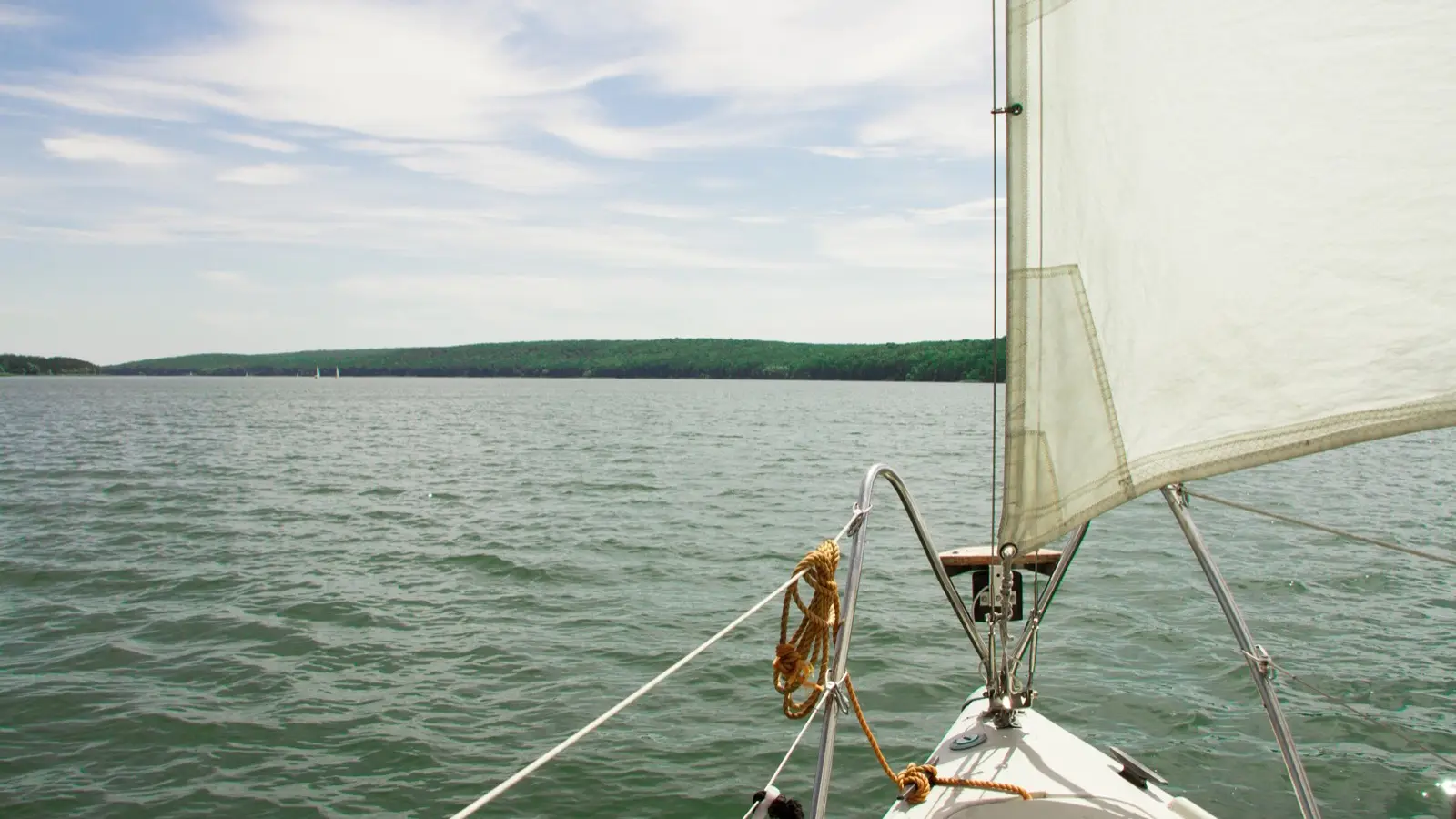

The RYA Day Skipper practical is five days living aboard a cruising yacht, skippering short passages by day and by night under the eye of an instructor. There is no exam. You are assessed continuously across the week, and you finish with the RYA Day Skipper Practical Course Completion Certificate, which is the qualification charter companies want to see and the one that lets you apply for an ICC.
What the RYA asks for before you join, the days, miles, night hours and age, is set out in our guide to the RYA Day Skipper requirements. This page is about the week itself. The one thing to know before reading on is that the practical assumes you already have the navigation. It is not a formal entry requirement, but the week is built on it, and studying the shorebased theory at home before you arrive is the single best preparation you can do.
I have run Day Skipper weeks from Hamble Point Marina for over 20 years. Here is what the five days look like, what we are watching for, and how to turn up ready.
The Day Skipper practical at a glance
The RYA defines the course by its length, the experience you bring and the standard you reach. Everything else is down to the school.
| RYA Day Skipper Practical (Sail) | |
|---|---|
| Course length | 5 days, or 3 weekends, or 3 days plus 2 days |
| Where it runs | Aboard a cruising yacht, living on board |
| Experience the RYA asks for | 5 days, 100 miles and 4 night hours on a sailing yacht |
| Assumed knowledge | Basic sailing ability, and navigation to Day Skipper shorebased level |
| Minimum age | 16 |
| Assessment | Continuous, by your instructor. No written or practical exam |
| Certificate | RYA Day Skipper Practical Course Completion Certificate |
| What it leads to | ICC application, RYA Coastal Skipper |
Source: RYA Course Finder, RYA Day Skipper Practical Sailing course, accessed 21 September 2026.
At Urban Truant we run it as five consecutive days from Hamble Point, with a maximum of three students to an instructor and a cabin each. Dates for the five-day course we run from Hamble Point are on the course page. If you still have the navigation to learn, the Day Skipper Complete package bundles the shorebased course with the practical week, so you study at home first and arrive with it fresh.
What the five days look like on the Solent
Every week follows the same shape: each day hands you a little more of the boat until, by Thursday, you are running it with the instructor quietly keeping an eye on safety.
Monday. Kit aboard, safety briefing, then straight to the chart table to work up the tidal heights and a plan out of the river. The first task afloat is boat handling under power: leaving the berth, turning in a tight marina, coming alongside again. Everyone gets several goes. Typically, the instructor will skipper the first passage to set the standard and demonstrate what you will need to do, which also gives you a chance to get to know the yacht.

Tuesday and Wednesday. Out into the Solent proper. Each Day Skipper takes a turn as skipper for a passage, which means the plan, the pilotage into an unfamiliar harbour, the sail handling and the crew briefing are yours. We anchor for lunch, pick up mooring buoys, practise man overboard recovery under power, and spend each night somewhere different: Cowes, Yarmouth, Lymington or the Beaulieu River, depending on tide and wind. Southampton Water gives you the collision regulations for real, with container ships and ferries that follow the rules and expect you to as well.
Thursday. A longer passage, often timed to a tidal gate, and the night sail. You prepare a pilotage plan for a harbour entrance in the dark, identify the lights you memorised on the shorebased course, and bring the boat in. This is the part of the week people talk about afterwards.

Friday. Passage back to the Hamble with a Day Skipper in charge, a debrief, and your certificate.
The Solent suits this course because the strong tides, busy shipping and closely spaced harbours mean you meet, in five days, the full syllabus.
How you are assessed, and whether you can fail
You are assessed continuously by your instructor, and the certificate is issued when you reach the standard of skippering a yacht safely on short coastal passages by day. There is no test at the end and no set of marks.
What we are watching for is decisions rather than polish. A perfect berth means less to us than a skipper who noticed the cross tide, briefed the crew before we arrived, and had a plan for the moment it went wrong. Passage plans that allow for the tide. Pilotage notes someone else could follow. A skipper who keeps looking out of the boat rather than sitting at the chart table.
Students who arrive with the experience the RYA asks for, and the shorebased course done, reach the standard in the week.
How to prepare for the Day Skipper practical
Three things: arrive with the navigation fresh, make sure the crew work is automatic, and pack for living aboard.
Do the shorebased course first
The practical does not teach navigation. It assumes it. On Monday you will be asked to work up the height of tide for an evening berth, and on Tuesday to plan a pilotage into a harbour you have never seen. If you are learning what a tidal curve is while the tide is pushing you sideways, you will spend the week a step behind.
Finish the shorebased course, then book the practical while it is still in your head. If you did it some time ago, the table below is what to revise. Our colleagues at Sailing Course Online have written up what the theory exam involves and where marks are lost; the same topics are where the practical bites.
| Navigation topic | Where it bites on the water |
|---|---|
| Tidal heights and the tidal curve | Every berth, anchorage and harbour entrance, from Monday afternoon |
| Tidal streams and course to steer | Any passage across the Solent; the tide runs hard and the plan has to allow for it |
| Pilotage plans, transits and clearing bearings | Each new harbour, and the night entry on Thursday |
| Lights, shapes and buoyage | Southampton Water and the Solent by day, the night sail in the dark |
| Collision regulations | Constantly, with commercial traffic that expects you to know them |
| Reading a forecast | Each morning's plan, and the decision about where to spend the night |
Make the crew work automatic
You cannot take charge of a boat while you are still learning where to put your hands on it. Reefing, coming alongside, handling a winch and steering a compass course should be things you do rather than things you have read about. If you are unsure, our guide to whether you should take Competent Crew first has an instructor's checklist, and steering on all points of sail is worth an evening if it has been a while.
Pack for a week aboard
Warm layers, soft-soled non-marking shoes, sun protection, a washbag, towel, sleeping bag and pillow, and a soft kitbag rather than a hard case. Bring your navigation notes. We provide lifejackets, harnesses and wet weather gear, and joining instructions come by email before the course. And don't forget to pack your sense of humour!
After the week
With the practical certificate you can apply to the RYA for an International Certificate of Competence, which is what most Mediterranean charter companies want to see; our colleagues at Sailing Course Online have a step-by-step guide to applying for an ICC. The next course up is Coastal Skipper, and the Coastal Skipper requirements explain the miles and night hours you need first, which most people gather with a few days of mile building.
Frequently asked questions
How do I prepare for the Day Skipper practical?
Finish the shorebased course and arrive with tidal heights, course to steer and pilotage fresh. Make sure you can reef, act as crew while berthing and steer a compass course without thinking about it, and log the 5 days, 100 miles and 4 night hours the RYA asks for.
Can you fail the Day Skipper practical?
There is no exam to fail. Your instructor assesses you across the week and issues the certificate when you have reached the standard. Students who arrive with the experience the RYA asks for, and the shorebased course done, reach the standard in the week.
Do I need the shorebased course before the practical?
The RYA does not list it as a formal entry requirement, but the practical assumes navigation knowledge to Day Skipper shorebased level and does not teach it. We strongly recommend doing the shorebased course first, which is what the Day Skipper Complete package is built for: the shorebased course at home, then the five days on the Solent.
How long does it take to become a Day Skipper?
Most people spread the shorebased course over one to three months. The practical is five days. Allowing time to log the experience the RYA asks for, most people go from nothing to a Day Skipper practical certificate within a season.
Do I stay on the yacht overnight?
Yes. You live aboard for the five days, with a different harbour each night. At Urban Truant everyone has a cabin of their own, and meals aboard are included.
How much does the Day Skipper practical cost?
At Urban Truant the five-day practical is £1,299 (September 2026), including your own cabin, meals aboard, mooring fees, fuel, wet weather gear and RYA certification. The Day Skipper Complete package, which adds the shorebased course, is £1,449, £110 less than booking the two separately. Prices elsewhere vary, so check the student to instructor ratio and what is included.
Ready for the week?
If you are not sure whether you are ready, ring us on 01489 250 040 and tell us what you have done.