
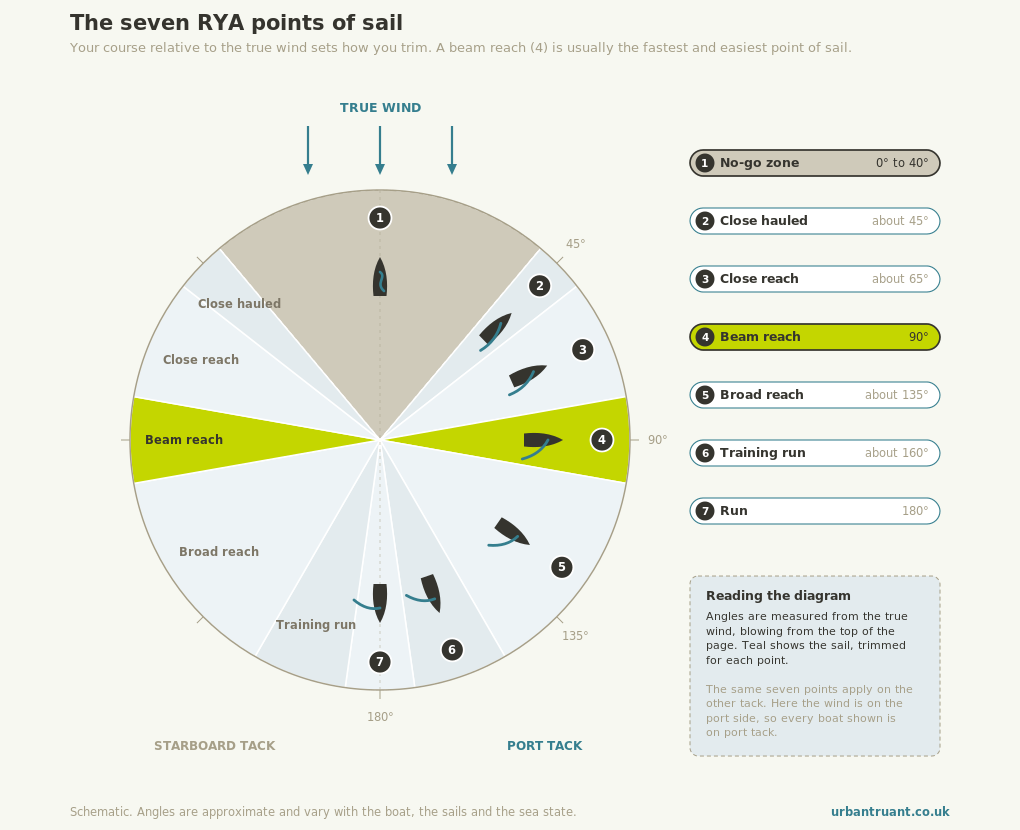
A point of sail is your boat's course relative to the direction the wind is blowing from, and it dictates how you trim your sails. The RYA teaches seven: the no-go zone, close hauled, close reach, beam reach, broad reach, training run and run. Working round from the wind, that runs from roughly 40° off the wind at close hauled, through 90° at a beam reach, to 180° on a dead run.
Everything else in sailing sits on top of this. Where you can go, how the boat feels, how hard she heels, which sail setting is right and which vessel gives way in a crossing situation all follow from your angle to the wind.
I have taught this on the Solent for years, and the students who pick it up quickest are the ones who stop thinking in compass courses and start thinking in angles off the wind and “feeling” where it is coming from. This guide covers all seven points, what to do with the sails on each, and the two things the diagrams rarely tell you: which one is actually fastest, and why your point of sail decides who gives way.
What are the points of sail?
The points of sail describe your heading relative to the true wind, which is the wind you would measure standing still. They are not compass directions and they change the moment the wind veers or backs, even if you hold the same course.
The wind gives you roughly 280° of usable options out of 360°. The missing slice is dead upwind, where a sail cannot generate drive. Everything outside it is sailable, and each segment has a name, an approximate angle and a sail setting that goes with it. That is why sailors talk in angles rather than bearings: telling crew to bear away to a broad reach means something on any boat, in any water, on any heading.
How many points of sail are there?
The RYA teaches seven points of sail. Many American sources give five or six, which is where most of the confusion online comes from.
The difference is in the counting rather than the sailing. The RYA includes the no-go zone as a named point, and separates the training run from the dead run. Sources that give five tend to drop both and list only close hauled, close reach, beam reach, broad reach and run.
If you are training in the UK or sitting an RYA course, work to seven, which is what the RYA's own guide to the points of sail sets out. The training run in particular earns its place, and I will come to why.
The seven points of sail
Each point is a range rather than a single angle, and the exact figures vary with the boat, the cut of the sails and the sea state. A modern racing yacht will point higher than a heavy long-keeled cruiser.
| Point of sail | Angle to the true wind | Sail setting | How it feels |
|---|---|---|---|
| No-go zone | 0° to about 40° | Flapping, no drive | Noisy, boat stops |
| Close hauled | about 45° | Sheeted in hard | Heeled, wet, working |
| Close reach | about 65° | Eased slightly | Fast and settled |
| Beam reach | 90° | About halfway out | Fastest and easiest |
| Broad reach | about 135° | Well eased | Quiet, boat sits up |
| Training run | about 160° | Almost fully out | Steadier than a dead run |
| Run | 180° | Right out, or goosewinged | Rolly, needs concentration |
The no-go zone
The no-go zone is the sector either side of the wind direction where a sailing boat cannot make progress. The RYA puts the edge at about 40° off the wind, which is about as close as most cruising yachts will sail. A well trimmed racing yacht with good sails will achieve closer angles though.
Point into it and the sails stop working as aerofoils. They flap, the boat slows, and steerage goes with the speed. A boat stuck head to wind with no way on is said to be in irons, and getting out means backing a headsail to push the bow round onto one tack. Every new sailor ends up there at some point, and it teaches wind awareness faster than any amount of explanation.
Close hauled
Sailing close hauled means sailing as close to the wind as the boat will go while still driving forward, with the sails sheeted in tight. On most cruising yachts that is around 45° off the true wind.
This is the point of sail that feels like hard work, and it should. The boat heels, the apparent wind is at its strongest, spray comes aft and the helm loads up in your hand. Sheets come in to pull the sails close to the centreline, and you steer to the wind rather than to a compass course, watching the luff of the headsail and the telltales.
Because you cannot sail directly upwind, reaching a point to windward means zigzagging across the no-go zone on alternating tacks. That is called beating to windward, and the RYA figure worth remembering is that you tack through about 90°, close hauled on one tack to close hauled on the other. Beating well is one of the things a Day Skipper practical week will polish, because it rewards practice more than explanation.
The commonest fault I see is pinching. The helm creeps up towards the wind chasing the mark, the telltales stall, and the boat quietly loses a knot while feeling like she is doing well. Bear away a few degrees and the speed comes back. You will actually make better progress to windward by doing this.
Close reach
A close reach sits between close hauled and a beam reach, at roughly 65° off the wind, with the sails eased a little from hard in.
It is a comfortable, quick point of sail. You have good drive and noticeably less heel and less water on deck, and the boat will hold a course without constant attention to the telltales.
Beam reach
A beam reach is sailing with the true wind at 90° to the boat, coming straight across the beam, with the sails eased to about halfway out. For most cruising yachts it is the fastest and easiest point of sail.
The reason is that the sails work close to their most efficient angle of attack while the boat stays upright enough to ease pressure on the keel and rudder, reducing the friction and allowing them to easily do their jobs. You are neither fighting heel as you do close hauled nor losing apparent wind as you do downwind.
It is also the point of sail where a boat is easiest to steer, so it is where I put nervous first-timers on the helm. Give someone a beam reach in fifteen knots on a settled Solent afternoon and they usually stop gripping the wheel within a couple of minutes.
Broad reach
On a broad reach, at roughly 135°, the wind comes over the quarter from behind and the sails are well eased. The boat sits up, the noise drops away and the motion goes easy.
Broad reaching flatters a boat, and it is worth being alert to that. Apparent wind has fallen well below true wind by this angle, so conditions feel gentler than they are. Crews get caught out turning back upwind after a long downwind leg and discovering what the breeze has actually been doing.
Training run
A training run has the wind slightly to one side of the stern rather than dead behind, at around 160°, with the sails almost fully out. The RYA teaches it as a point in its own right, and the American guides usually leave it out.
It earns its place because it is meaningfully easier and safer to steer than a dead run. With the wind clearly on one side of the stern you always know which side the boom wants to be on, and you have a margin of error before the wind gets behind the mainsail and gybes it across.
On passage, most experienced crews sail a training run rather than a dead run for exactly that reason, tacking downwind in a series of shallow zigzags. It usually turns out to be quicker as well as calmer.
Run
A run is sailing dead downwind at 180°, with the wind directly astern and the sails right out. It is the trickiest point of sail to hold.
With the mainsail out one side, the headsail sits in its wind shadow and collapses, so you either set it on the opposite side, which is sailing goosewinged, or hoist a spinnaker. The boat rolls too, because there is no steadying push from the sails to lean against.
The real hazard is the accidental gybe. Let the stern cross the wind by a few degrees and the boom slams across the boat uncontrolled, which is how people get hurt and rigs get damaged. Rig a preventer if you are running for any length of time, and put your most attentive helm on the wheel.
Which point of sail is fastest?
For a cruising yacht, a beam reach is usually the fastest point of sail. Some sources say a run is fastest, which sounds reasonable and is wrong for most boats.
The reason is apparent wind, the wind you actually feel on deck. On a run, your boat speed subtracts from the true wind, so a yacht doing six knots dead downwind in fifteen knots of true wind feels only nine knots across the deck. On a beam reach the two combine, the sails see more wind, and the boat goes faster.
Fast dinghies, catamarans and foiling boats change the picture, because they generate so much apparent wind that they are quicker sailing hot angles downwind than aiming straight at the mark. For a cruising yacht on the Solent, the beam reach holds.
True wind and apparent wind
True wind is the wind over the water; apparent wind is the combination of true wind and the wind created by the boat's own movement. Sails respond to apparent wind, which is why trim changes as your speed changes.
| True wind | Apparent wind | |
|---|---|---|
| What it is | Wind measured from a stationary point | Wind felt on a moving boat |
| Used for | Forecasts, passage planning, naming your point of sail | Sail trim, steering, tactics |
| Upwind | Unchanged | Stronger and further forward |
| Downwind | Unchanged | Weaker and further aft |
The safety consequence matters more than the physics. Sailing downwind feels calmer than the conditions really are, which is why crews sail on over-canvassed and only find out when they turn back upwind. Reading a forecast properly before you leave is the other half of that, and the Short Range Certificate covers how you get updates once you are out there. If a downwind leg feels easy, check the instruments before you assume it is.
Sail trim on each point of sail
The rule that covers almost every situation is this: ease the sail out until the front edge starts to flap, then pull it in just until the flapping stops. That gives you the correct trim for the point of sail you are on, whatever the boat.

Turning towards the wind is heading up, and you sheet in as you go. Turning away from the wind is bearing away, and you ease the sheets. Every change of course needs a matching change of trim, even a small one.
| Point of sail | Sheet position | Common mistake |
|---|---|---|
| Close hauled | In hard, near the centreline | Pinching up and stalling |
| Close reach | Eased a hand's width | Leaving sails sheeted in hard |
| Beam reach | About halfway out | Under-easing, so the boat heels |
| Broad reach | Well out | Forgetting the headsail |
| Training run | Almost fully out | Letting the wind creep aft |
| Run | Fully out or goosewinged | No preventer |
Telltales are the quickest feedback you have. On a headsail, both sets streaming aft means you are trimmed and steering well. The windward set lifting means you are too close to the wind, and the leeward set fluttering means you are too far off it.
Port tack or starboard tack, and why it matters
Your tack is named for the side the wind is coming over. Wind over the port side puts you on port tack, wind over the starboard side puts you on starboard tack, and this holds on every point of sail.
The quickest check on the water is the boom. Under the collision regulations the windward side is taken to be the side opposite the one the mainsail is carried on, so a boom out to starboard means the wind is on the port side and you are on port tack.
This is where a beginner's topic becomes a rules-of-the-road topic. Under IRPCS Rule 12, when two sailing vessels have the wind on different sides, the one with the wind on the port side keeps out of the way. When both have the wind on the same side, the windward boat keeps clear of the leeward boat.
| Situation | Who keeps clear |
|---|---|
| Wind on different sides | The boat on port tack |
| Wind on the same side | The windward boat |
| You cannot tell which tack the other boat is on | You do, if you are on port tack |
So the answer to which boat gives way starts with a question about points of sail. That connection is why the collision regulations sit in the shorebased syllabus rather than being left to the practical course, and it is topic 04 of the 17 topics on our Day Skipper theory course.
Changing between points of sail: tacking and gybing
Moving between points of sail on the same tack is a matter of steering and trimming. Changing tack takes one of two manoeuvres.
Tacking turns the bow through the wind, crossing the no-go zone from close hauled on one tack to close hauled on the other, through roughly 90°. Gybing turns the stern through the wind, taking the boom across from one side to the other, and needs controlling because the boom travels fast.
Once you are working out how far to sail on each tack to reach a mark, you are into laylines, and from there into tidal drift and working out a course to steer. That is the point where points of sail stops being a beginner's diagram and becomes passage planning, and it is the thinking a Coastal Skipper week is built around.
How the points of sail are taught on an RYA course
Points of sail come up on the first morning of almost every practical sailing course, and they land properly only once you have felt them.
On a first weekend afloat you meet the names and steer through a few of them. On five days learning to be useful as crew you trim for each one often enough that it becomes automatic. By Day Skipper you are choosing points of sail as tactical decisions, weighing tide and wind angle against where you actually want to end up.
The Solent suits this well. You can sail a beam reach across to the Island, harden up for a beat back against the tide and finish on a broad reach into the Hamble inside an afternoon, which gives students all seven points in one sail with shelter close at hand. If you have not sailed at all yet, our guide on how to learn to sail a yacht in the UK sets out the whole pathway.
Frequently asked questions
What are the five points of sail?
Sources that list five usually give close hauled, close reach, beam reach, broad reach and run. The RYA teaches seven by adding the no-go zone and the training run. For UK training, work to seven.
What is the most efficient point of sail?
A beam reach, for most cruising yachts, because the sails work at a good angle of attack while the boat stays upright and apparent wind stays strong. High-performance multihulls and foiling boats are quicker at hotter angles.
How do I remember port or starboard?
Port and left are both four letters. Port has a red navigation light, and port wine is red. On the water, your tack is named for the side the wind comes over, so the boom out to starboard means you are on port tack.
What does close hauled mean?
Sailing close hauled means sailing as close to the wind as the boat will go while still making progress, with the sails sheeted in hard, at about 45° off the true wind on a typical cruising yacht.
What is the difference between a broad reach and a run?
On a broad reach the wind comes over the quarter at about 135° and the sails still generate lift across their surface. On a run the wind is dead astern at 180°, the sails are being pushed, and the headsail is blanketed by the main unless you goosewing.
What is a training run?
A training run has the wind slightly to one side of the stern at around 160° rather than dead behind. It is easier to steer than a dead run and carries far less risk of an accidental gybe.
How wide is the no-go zone?
Roughly 40° either side of the wind direction, so about 80° to 90° in total. Modern racing yachts sail closer, and heavy long-keeled boats less close.
Do points of sail apply to motorboats?
No. A motorboat's heading is independent of the wind. Wind still affects handling, drift and comfort, and it matters a great deal when you are berthing, but the points of sail themselves are for sailing vessels. If power is where you are heading, start with our guide to the RYA Powerboat Level 2 course.
Come and feel the difference
Reading about the points of sail gets you the vocabulary. Sitting on the helm as the boat comes up from a broad reach to close hauled, feeling her stand up and load into your hand, is what makes them stick. We teach all seven on the water from Hamble Point Marina, with a maximum of three students to an instructor, so you get the helm rather than watching someone else have it.