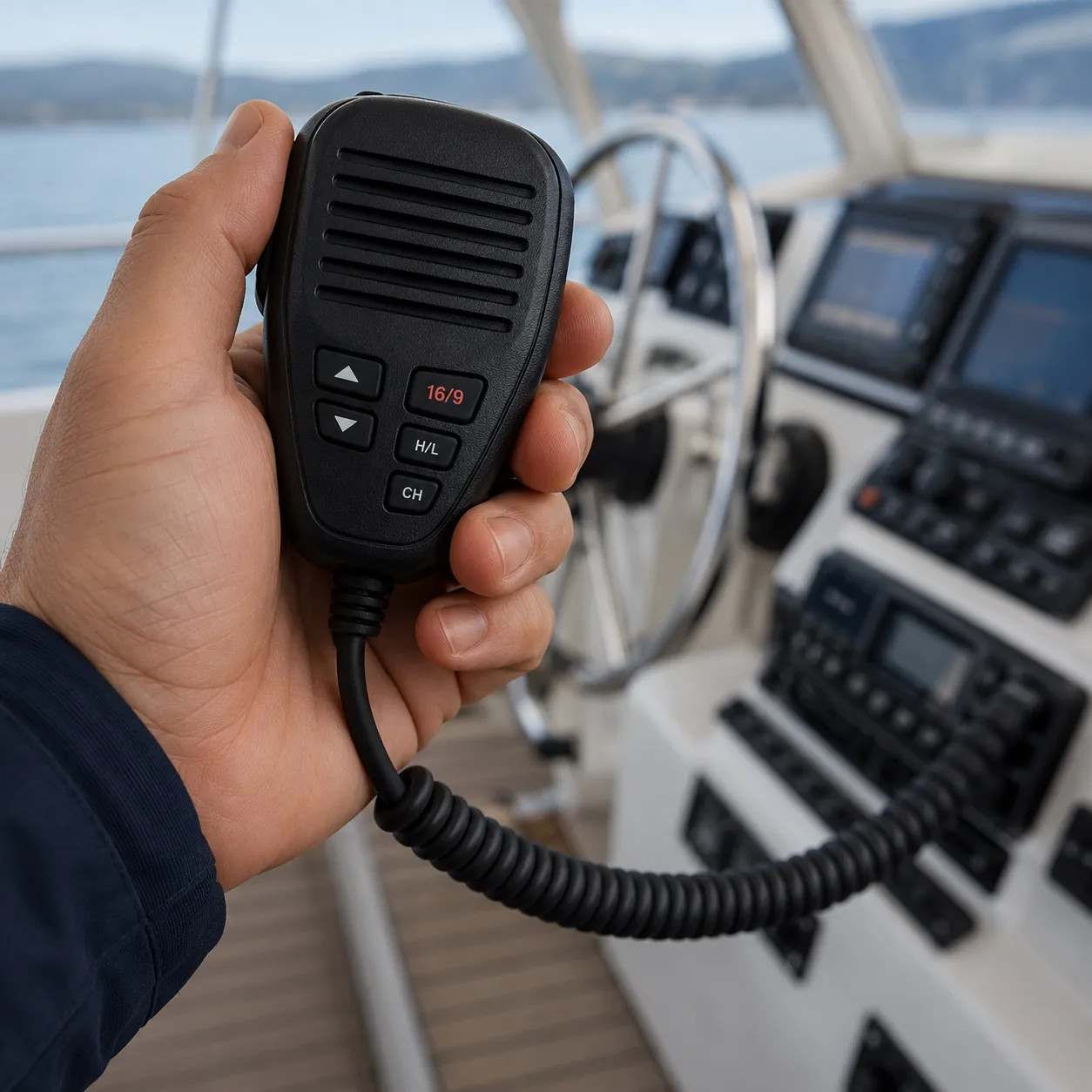

The RYA Marine Radio Short Range Certificate, formally called the VHF Radio Certificate, is the qualification you need to legally operate a marine VHF radio on a British-flagged vessel. It is a one-day course or 6 to 8 hours of self-paced online study, followed by a practical exam at an RYA Recognised Training Centre.
The total cost in 2026 sits at around £146 (£70 for the online course from a centre like ours, plus a £76 exam fee paid directly to the RYA). There are no prerequisites, the certificate is valid for life, and it is recognised internationally.
If you sail or motor anywhere in UK waters with a fitted radio, you need this qualification. The same applies if you are working towards your Yachtmaster, planning a charter abroad, or looking at commercial work on the water.
What is the RYA Marine Radio Short Range Certificate course?
The RYA Marine Radio Short Range Certificate teaches you how to operate a marine VHF radio safely and legally. It is the route to obtaining the Short Range Certificate (SRC), which the RYA describes as “the minimum qualification required to operate marine VHF radio equipment on a UK flagged vessel”.
The course covers two things in roughly equal measure: routine operation, such as calling a marina for a berth or speaking to another vessel, and emergency procedures, including Mayday, Pan-Pan, and Securité calls.
It also covers Digital Selective Calling (DSC), the system that (amongst other things) lets a modern VHF radio send a Distress Alert at the press of a button, automatically transmitting your vessel’s identity and GPS position to HM Coastguard and all other vessels and stations in range if they are equipped with DSC functionality.
The qualification is regulated by Ofcom and managed by the RYA on behalf of the Maritime and Coastguard Agency. It is recognised internationally under the CEPT SRC framework.
Who needs the Marine Radio Short Range Certificate?
Anyone transmitting on a marine VHF radio in UK waters needs an SRC. Specifically:
- Recreational sailors and motorboaters with a fixed or handheld VHF on board. Operating a marine radio without an SRC is an offence under the Wireless Telegraphy Act 2006.
- RYA Yachtmaster™ candidates. The SRC is a pre-entry requirement for the Yachtmaster Coastal, Offshore, and Ocean exams. You cannot sit the practical exam without it.
- Anyone applying for a commercial endorsement to work as a paid skipper, instructor, or delivery crew.
- Charter customers. Many bareboat operators in the Mediterranean and Caribbean require the SRC alongside your Day Skipper practical course or ICC.
- Yacht club members at clubs with radio-fitted club boats. Most require the SRC before letting members take charge.
In a genuine emergency, anyone can use a VHF radio to make a distress call regardless of qualifications. The SRC requirement is about everyday operation, where misuse of maritime frequencies can block safety traffic.
What does the Marine Radio Short Range Certificate cover?
The syllabus is set by the RYA and consistent across providers. The course covers the following:
- Radio waves and how VHF works. Why range is limited to roughly 20 to 30 nautical miles for a fixed set at masthead height, and 3 to 5 miles for a handheld at deck level.
- The VHF/DSC radio set. Squelch, channel selection, power settings, the microphone, and how to make a clear transmission.
- GMDSS and MMSI numbers. The Global Maritime Distress and Safety System, and how your vessel’s nine-digit MMSI identifies you on DSC.
- Channel usage. Channel 16 for distress and calling, Channel 70 for DSC only, Channel 80 for UK marinas, plus working channels for the Coastguard and inter-ship traffic.
- Routine procedures. How to call another vessel, marina, or port authority, and how to switch to a working channel.
- Distress, Urgency, and Safety calls. Full Mayday for the most serious situations, Pan-Pan for urgent non-life-threatening situations, and Securité for navigational warnings.
- Phonetic alphabet and pro-words. Alpha (A) to Zulu (Z), “Over”, “Out”, “Say Again”, and the rest of the standardised voice procedure.
- Related safety equipment. EPIRBs, SARTs, Navtex, and AIS, and how each fits into the GMDSS.
- Licensing requirements. The Ofcom Ship Radio Licence (free, lifetime), MMSI allocation, and the role of the SRC certificate itself.

If you want to understand how to actually use a VHF radio in practice, we have a longer companion guide on operating the radio at sea on the Sailing Course Online blog.
How long is the RYA Marine Radio Short Range Certificate?
The RYA specifies a minimum of 6 to 8 hours of structured learning for the SRC syllabus, which makes it one of the shortest RYA shorebased qualifications.
You have two ways to complete it:
Online (self-paced). Most students take between 6 and 8 hours spread over several sessions. You work through the RYA Interactive course modules at your own pace, complete a knowledge check, and then attend an in-person practical exam separately.
Classroom (one day). A full day, typically 09:00 to 17:00, with the practical exam either at the end of the same day or scheduled shortly after.
Both routes cover the same syllabus and lead to the same RYA certificate. The choice is about how you learn best.
Online versus classroom: which works better?
There is no right answer to this, but here is how it tends to break down:
| Online | Classroom |
|---|---|
| Work around your existing schedule | Done in a single day |
| Replay difficult sections as needed | Direct instructor-led practice on real radios |
| Cheaper upfront (no classroom overhead) | Exam typically taken the same day |
| Exam booked separately at a centre | One trip, course and exam together |
| Best if you self-direct well | Best if you learn through structured group practice |
The course content is identical. The difference is in pacing and delivery.

The one universal point is that the practical exam must be taken in person at an RYA Recognised Training Centre. There is no remote SRC exam. So whichever route you take for the learning, you will need to attend a centre to be assessed.
What does the RYA VHF course cost?
In 2026, the full cost of getting your SRC qualification in the UK breaks down as follows:
| Item | Cost |
|---|---|
| RYA Interactive online course (via Urban Truant) | £70.00 |
| RYA SRC exam fee | £76.00 |
| Total | £146.00 |
The RYA’s official exam fee, set centrally by the RYA, is currently £76 (as of May 2026).
Be aware that the headline price advertised by online providers is rarely the full cost. The RYA exam fee is almost always paid separately, on top of the course fee. Some providers fold it into a single price, others quote the course fee only. When you are comparing prices, check whether the £76 exam fee is included or extra.
There is also a separate Ship Radio Licence, which Ofcom issues to license the equipment on your boat. This has been free of charge since 2006 and is valid for the lifetime of the vessel. You can apply directly through the Ofcom Ship Radio Licence page.
What happens in the SRC exam?
The exam has three parts and takes around 90 minutes from start to finish:
- Pre-assessment knowledge check completed online before you attend.
- Written paper of around 25 questions covering procedures, regulations, and equipment.
- Practical assessment using a real or simulated VHF DSC radio, working through routine calls, serious situations, and DSC functions.

At our Hamble base, we use real VHF DSC sets modified for training so you can practise Distress calls without broadcasting them live. Most candidates pass first time, particularly those who have worked through the online content properly beforehand. The practical assessment is the part that catches people out, and it is usually because they have read about the procedures but never said them out loud.
Bring a passport-sized photograph on the day. Your certificate is processed by the RYA after the exam and posted to you. Once issued, it is valid for life.
How the RYA Marine Radio Short Range Certificate fits into your sailing pathway
The SRC is one of the most useful qualifications you can hold on its own, and it is also a building block for almost everything that comes next in the RYA scheme. Specifically:
- Day Skipper. Not a formal prerequisite, but most students complete both around the same time, often as part of a combined package. See our Day Skipper Requirements guide for the full picture.
- Yachtmaster Coastal, Offshore, and Ocean. The SRC is a mandatory pre-entry requirement for all three Yachtmaster exams. Most candidates pair the SRC with our Yachtmaster prep theory course.
- Commercial endorsement. Required for the commercial endorsement, alongside Sea Survival, First Aid, PPR, and an ML5 medical.
- ICC for charter. The SRC is recognised abroad and frequently asked for by Mediterranean charter companies.
- Powerboating. Pairs naturally with the Powerboat Level 2 qualification for anyone driving a fitted RIB or motorboat.
If you are working towards Yachtmaster, do your SRC early. Leaving it to the week before your prep course is one of the most common scheduling problems we see, and it is entirely avoidable.
What’s included with our RYA Marine Radio Short Range Course
We are an RYA Recognised Training Centre based at Hamble Point Marina on the Solent, and we have been delivering RYA training to students from 115 countries since 2012. Our SRC course includes:
- Access to the official RYA Interactive SRC/VHF online course
- The RYA VHF Handbook (G31), posted within one working day or available as an eBook for instant access
- Support from RYA Yachtmaster™ Instructors during your study
- Practical examination at our Hamble Point Marina base
- Application paperwork handled by us, so your certificate reaches you with no admin overhead
We hold Feefo Platinum Trusted Service status (2022 to 2026) with a 4.9-star rating across our courses, and we have trained personnel for the RYA and Maritime and Coastguard Agency.
Book the SRC course with us at Hamble →
Frequently asked questions
Do you need a licence to use a VHF radio in the UK?
Yes. UK law requires two things: a Ship Radio Licence from Ofcom (free, lifetime) covering the equipment, and an SRC operator’s certificate (£146 all-in) covering the person using it. Operating a VHF without both is an offence under the Wireless Telegraphy Act 2006. In a genuine emergency, anyone can use a radio to call for help regardless of qualifications.
How much does the RYA Marine Radio Short Range Certificate cost in 2026?
The total cost is around £146: £70 for the online course at Urban Truant, plus the RYA’s £76 exam fee paid directly. Some providers quote the course fee only, so check whether the exam fee is included when comparing prices.
Can you do the RYA SRC exam online?
No. The practical exam must be taken in person at an RYA Recognised Training Centre. You can complete the theory online, but you will need to attend a centre such as ours at Hamble Point Marina to be assessed using a real VHF DSC radio.
How long is an SRC certificate valid for?
The RYA SRC is valid for life. There is no renewal, no revalidation, and no continuing assessment. Once issued, your certificate stays with you.
Do I need to do the RYA Marine Radio Short Range Certificate before my Yachtmaster exam?
Yes. The SRC is a mandatory pre-entry requirement for all three Yachtmaster exams (Coastal, Offshore, and Ocean). The RYA will not accept your booking without it. We recommend completing your SRC well in advance of your Yachtmaster prep week to avoid last-minute scheduling problems.
Is there a minimum age for the RYA VHF course?
You can take the course at any age, but you must be at least 16 on the day of the exam to be eligible for the SRC certificate.
Ready to start?
If you are ready to book, you can book the SRC course with us at Hamble and we will send your handbook and online course access within one working day. The practical exam can be scheduled at our Hamble Point Marina base most weekdays.
If you would rather talk it through first, give us a call on 01489 250 040 or drop us an email. We are happy to help you work out whether the SRC fits into your wider sailing plans, particularly if you are weighing it up alongside Day Skipper or Yachtmaster prep.